
Sunderland captain and Switzerland midfield general Granit Xhaka has once again proven why he is regarded as one of football’s sharpest tactical minds after appearing to identify a potential loophole in FIFA’s newly introduced throw-in countdown rule during the 2026 World Cup.
Granit Xhaka Spots Potential Loophole in FIFA’s New Throw-In Countdown Rule at 2026 World Cup
Sunderland captain and Switzerland midfield general Granit Xhaka has once again proven why he is regarded as one of football’s sharpest tactical minds after appearing to identify a potential loophole in FIFA’s newly introduced throw-in countdown rule during the 2026 World Cup.
The regulation, brought into effect by the International Football Association Board (IFAB) ahead of this summer’s tournament, was designed to combat time-wasting and speed up the flow of matches. Under the new law, referees can initiate a visible five-second countdown when they believe a player is deliberately delaying a throw-in or goal kick. Failure to restart play before the countdown reaches zero results in possession being handed to the opposition.
However, it did not take long for experienced professionals to begin testing the boundaries of the rule, and Xhaka was among the first to attract attention.
During Switzerland’s latest World Cup outing, the veteran midfielder was observed calmly assessing his options from a throw-in situation while carefully managing the countdown process. Rather than rushing the restart, Xhaka appeared to use subtle movement and communication with teammates to reset the sequence and avoid triggering a turnover, sparking discussion among fans, pundits and former officials.
The incident quickly gained traction on social media, with many supporters praising the former Premier League star’s football intelligence. Others questioned whether FIFA may need to further clarify the wording of the law if players can legally manipulate situations to extend the time available before the countdown becomes decisive.
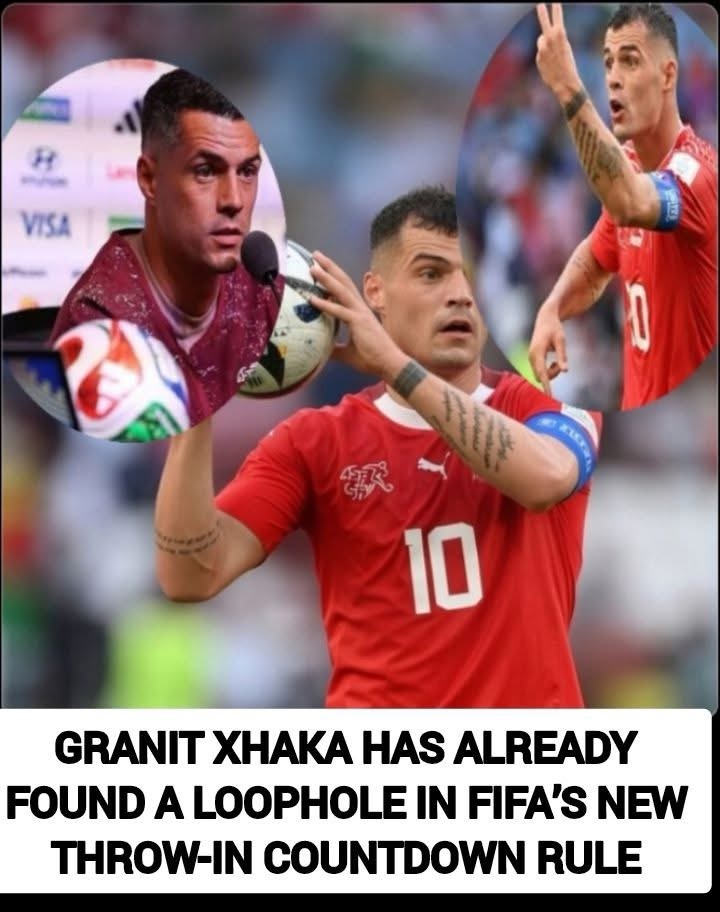
Football analysts noted that new regulations often undergo a period of adjustment as players, coaches and referees learn how they operate in competitive environments. Similar situations occurred following the introduction of added-time reforms, goalkeeper time restrictions and changes to handball interpretations in recent years.
Speaking after the match, several observers highlighted Xhaka’s vast experience at both club and international level as a key factor behind his quick adaptation.
“Top players always find the grey areas,” one commentator remarked. “The rules can change, but footballers with Xhaka’s understanding of the game are constantly looking for ways to gain an advantage within the laws.”
The debate has reignited discussions about whether the five-second countdown will achieve its intended purpose throughout the tournament. While FIFA hopes the measure will eliminate unnecessary delays, critics argue that players may continue to discover legal methods of slowing the game without technically violating the rule.
For now, no official complaint or disciplinary action has emerged from the incident, meaning Xhaka’s actions remain firmly within the laws of the game. Nevertheless, the moment has already become one of the most talked-about tactical talking points of the World Cup.
As the tournament progresses, referees and officials will be watching closely to see whether other players follow Xhaka’s lead—or whether FIFA is forced to refine the rule further to close any loopholes that may exist. The Switzerland captain may not have scored a goal, but once again he has found himself at the centre of a football debate, demonstrating that intelligence and experience can be just as influential as technical ability on the world’s biggest stage.