💥 WOLVES DRAMA EXPLODES! — PEIXOTO FORCED TO ANSWER AFTER AROKODARE TRAINING CONTROVERSY
PEIXOTO FACES QUESTIONS AFTER AROKODARE TRAINING CONTROVERSY — WOLVES BOSS UNDER PRESSURE AS TRAINING-GROUND DRAMA ERUPTS
Wolverhampton Wanderers manager Cesar Peixoto has found himself facing uncomfortable questions after a reported training-ground confrontation involving Nigerian striker Tolu Arokodare plunged the club into another storm during a crucial period of transition.
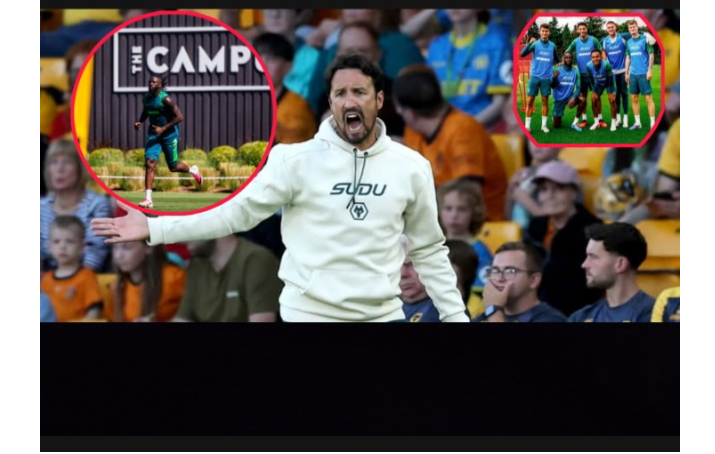
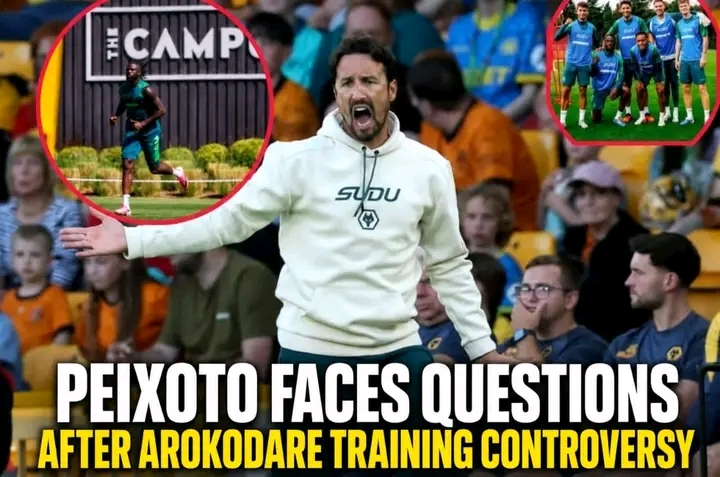
What was expected to be a period of rebuilding at Wolves has instead been overshadowed by uncertainty surrounding one of the club’s most talked-about players. Reports from July claimed that a first-team training session at Compton Park was cancelled following a disagreement involving Arokodare, with the striker allegedly refusing to leave the pitch after being told he would not train with the senior group.
The incident immediately raised questions about the relationship between the forward and Peixoto, who had only recently taken charge and was attempting to establish his authority over a squad facing a new challenge in the Championship.
For a manager arriving at a club desperate to rebuild its identity, the timing could hardly have been more difficult.
AROKODARE SITUATION ESCALATES
The controversy reportedly stemmed from uncertainty over Arokodare’s future at Molineux.
The Nigerian striker had been linked with a move away from Wolves, with reports suggesting that his preference was to pursue a transfer elsewhere. The situation became increasingly complicated when reports emerged claiming that he had protested during training.
According to multiple reports, Arokodare remained on the pitch despite being instructed not to participate with the first team, forcing Peixoto to halt the session. Additional security was subsequently reported to have been present at the training ground.
That version of events created an explosive narrative.
However, Arokodare later publicly pushed back against the reports, saying that he was surprised and disappointed by coverage that he believed did not accurately represent what had happened.
That response is important because it means the full circumstances surrounding the incident remain disputed.
PEIXOTO’S AUTHORITY QUESTIONED
Despite the conflicting accounts, the episode inevitably placed Peixoto under the spotlight.
A new manager needs to establish clear standards, particularly at a club attempting to recover from relegation. Peixoto has been tasked with creating a disciplined and competitive Wolves side, and allowing uncertainty over one player’s status to dominate the headlines is hardly ideal.
At the same time, the manager must carefully balance authority with squad management.
If a player is unhappy with his situation, the solution cannot simply be played out in public. The manager, player and club hierarchy must find a way to resolve the disagreement without allowing it to damage the wider dressing room.
That is why the Arokodare situation represents a significant test for Peixoto.
His response could influence how players view his leadership and how supporters judge his ability to handle difficult personalities.
TRANSFER UNCERTAINTY ADDS FUEL
The transfer situation has made everything considerably more complicated.
Arokodare’s future had already been the subject of speculation, and the training-ground reports only intensified the uncertainty.
The striker joined Wolves from Genk and entered a squad that was preparing for life outside the Premier League. Naturally, questions emerged over whether he would remain central to Peixoto’s plans or become part of the club’s efforts to reshape the squad.
Reports subsequently linked the player with potential moves, including interest from Fiorentina.
But transfer speculation can quickly become destabilising when a player remains at the club.
Every training session becomes a talking point. Every omission from a squad creates questions. Every statement from the player or manager can be interpreted as evidence of a deeper disagreement.
That is precisely the situation Wolves have found themselves in.
WOLVES CANNOT AFFORD ANOTHER DISTRACTION
The timing is particularly frustrating for Wolves supporters.
After relegation, the club needs stability. The Championship demands consistency, focus and togetherness, particularly for a team expected to compete strongly after dropping out of the Premier League.
Instead, attention has repeatedly shifted away from football and towards internal issues.
Peixoto therefore faces a difficult challenge: he must make sure the Arokodare situation does not become bigger than the team itself.
The manager’s job is not simply to pick the starting XI. He must manage personalities, maintain discipline and convince players that everyone is working towards the same objective.
If Arokodare remains at Molineux, Peixoto will have to decide whether there is a pathway back into his plans.
If the player leaves, Wolves will need to ensure the transfer does not leave a significant weakness in the squad.
Either way, a clear resolution is essential.
AROKODARE’S RESPONSE CHANGES THE PICTURE
Perhaps the biggest development in the entire saga was Arokodare’s decision to respond publicly.
Rather than allowing the allegations to define him, the striker insisted that some of the reports were inaccurate. His statement presented a different perspective and ensured that the controversy could not simply be viewed as a straightforward case of player misconduct.
That leaves Wolves with an awkward situation.
There are competing narratives, and the club must now manage the matter carefully.
For supporters, the unanswered questions are obvious.
What exactly happened at training?
Why was the session cancelled?
What did Peixoto say to Arokodare?
And, most importantly, can the relationship between the manager and player be repaired?
Until those questions are settled, speculation will continue.
PEIXOTO’S BIGGEST TEST MAY NOT BE ON THE PITCH
Peixoto’s early months at Wolves were always going to be demanding.
But the Arokodare controversy has presented him with a challenge that goes beyond tactics and formations.
It is a test of leadership.
Wolves need their manager to demonstrate that difficult situations can be handled decisively without allowing them to consume the club. The Portuguese coach must now ensure that the focus returns to performances, results and the long-term rebuilding project.
The Arokodare saga may eventually become a forgotten chapter.
But if the situation drags on, it could become one of the defining stories of Peixoto’s early tenure.
For now, Wolves supporters are left waiting for clarity.
The club needs unity.
Peixoto needs authority.
Arokodare needs his future resolved.
And Wolves need everyone focused on the same target.
After the reported training-ground drama, the biggest question is no longer simply what happened between the manager and striker.
It is whether Peixoto can turn a difficult situation into a demonstration of strong leadership — before the controversy becomes a bigger problem than the football itself.