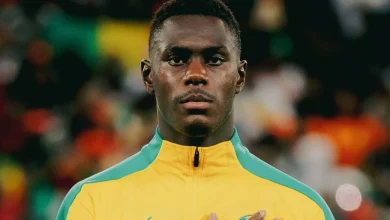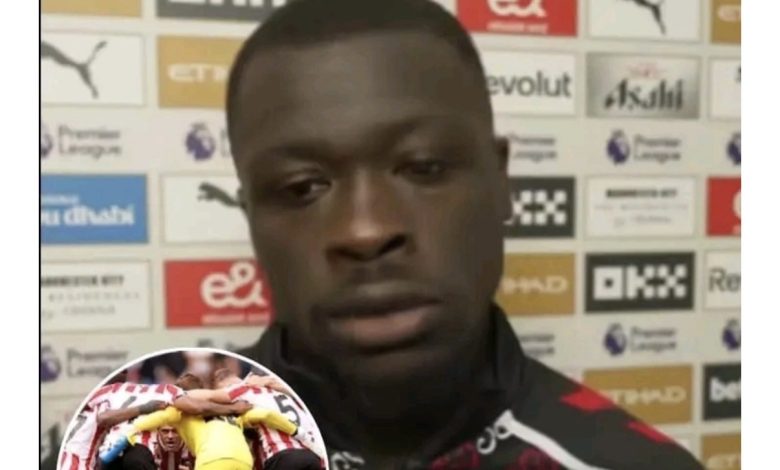
Brian Brobbey has gone viral after producing a remarkable moment of humility following his outstanding performance against Manchester City, insisting that his teammate deserved the Man of the Match award instead of him.
Brian Brobbey Goes Viral After Telling Sky Sports to Give His Man of the Match Award to His Teammate Despite Stunning Display Against Man City
Brian Brobbey has gone viral after producing a remarkable moment of humility following his outstanding performance against Manchester City, insisting that his teammate deserved the Man of the Match award instead of him.
The forward was one of the standout players on the pitch, delivering a performance that immediately attracted attention from supporters, pundits and viewers watching the game. His contribution was central to his side’s display, with his movement, physicality and attacking threat causing problems for Manchester City throughout the match.
Yet despite receiving widespread praise for his own performance, Brobbey appeared more interested in highlighting the contribution of a teammate.
Speaking after the final whistle, the striker reportedly made his feelings clear when discussing the Man of the Match award.
“Listen, I’ll be honest—everyone’s talking about me, but he was different class today. If anyone deserves that Man of the Match, it’s him, not me.”
The comment quickly caught the attention of football fans.
In an era where individual awards and statistics often dominate post-match discussions, Brobbey’s reaction stood out. Rather than focusing on his own numbers or performance, he directed the attention toward a teammate whom he believed had been even more influential.
His second statement only added to the reaction.
“I might’ve had a good game, but what he did out there? That was on another level. Give him the award—he earned it, no question.”
The comments have since sparked plenty of discussion among supporters, with many praising the forward for putting the team’s performance ahead of individual recognition.
Brobbey’s display itself was difficult to ignore.
From the opening stages of the match, he looked determined to make an impact. His physical presence gave City’s defenders plenty to think about, while his ability to hold the ball up allowed his teammates to move forward and support attacks.
Against a Manchester City side renowned for controlling possession and dictating the tempo, Brobbey’s ability to compete physically and provide an outlet was particularly important.
Whenever his team won possession, he offered a forward option.
Whenever City attempted to build from the back, he was prepared to apply pressure.
And whenever opportunities developed in the final third, he remained a constant threat.
That combination helped make his performance one of the major talking points after the match.
However, Brobbey’s willingness to praise his teammate demonstrates another side of the performance.
Football is increasingly dominated by statistics. Goals, assists, chances created, successful passes, expected goals and other numbers are regularly used to determine who had the biggest influence on a match.
But Brobbey appeared to suggest that the numbers only tell part of the story.
“Sometimes stats don’t tell the full story… he ran the game from start to finish. For me, he was the best player on the pitch—simple as that.”
That particular comment resonated with supporters because it highlighted something often overlooked in football: the importance of performances that do not always appear spectacular on a statistical sheet.

A midfielder can control the rhythm of a match without scoring.
A defender can dominate without making headlines.
A forward can create space for others without registering an assist.
And a player can influence the entire structure of a team without necessarily being the person receiving the biggest individual award.
Brobbey appeared to recognise exactly that.
While he was receiving praise for his own performance, he believed his teammate had played an even more important role.
The reaction from fans was immediate.
Some supporters described Brobbey’s comments as a refreshing example of team-first mentality. Others argued that the moment showed how highly respected the unnamed teammate is within the dressing room.
There was also plenty of admiration for Brobbey himself.
Performing at a high level against Manchester City is already a major achievement for any attacker. Doing so while simultaneously refusing to take all the credit made the moment even more memorable.
His comments also demonstrated the competitive nature of the match.
Manchester City are accustomed to dominating possession and controlling games, meaning opponents often have to work extremely hard to disrupt their rhythm.
Brobbey’s performance represented a different challenge.
His strength allowed him to compete with defenders, while his movement gave City’s back line another problem to deal with.
He was not simply waiting for chances to arrive.
Instead, he remained involved in the game and attempted to influence proceedings whenever possible.
That was one reason his performance generated such a strong reaction.
Even when Manchester City had periods of control, Brobbey continued to provide an attacking outlet.
His willingness to compete for difficult balls also allowed his teammates to push higher up the pitch.
For a striker, that kind of contribution can be just as valuable as scoring.
The biggest talking point, however, remained his decision to redirect the Man of the Match conversation toward his teammate.
It is particularly notable because individual awards can become significant moments for players.
Being named Man of the Match against a club of Manchester City’s stature can increase a player’s profile and generate headlines.
Brobbey could easily have accepted the praise.
Instead, he effectively told everyone watching that the recognition belonged elsewhere.
That attitude has helped turn what was already an impressive performance into a major talking point.
Fans have also pointed out that such moments can reveal the mentality inside a team.
When players publicly acknowledge each other’s performances, it can strengthen the sense of unity within a squad.
Brobbey’s comments suggested that he was more concerned about celebrating the collective performance than collecting individual recognition.
The forward’s performance also showed why he can be such a difficult player for opposition defenders to handle.
His physical strength, direct running and ability to occupy defenders can change the way opponents defend.
Against Manchester City, those qualities were particularly noticeable.
City’s defenders could not afford to ignore his positioning because even a small amount of space could allow him to turn, run at the defence or bring another attacker into play.
That constant threat meant Brobbey remained relevant throughout the contest.
Even when he was not directly involved in an attacking move, his positioning could affect how City’s defenders arranged themselves.
For that reason, supporters have continued to discuss his contribution long after the final whistle.
Yet Brobbey himself did not appear interested in making the match about him.
His words instead placed the spotlight on his teammate.
The statement also reflects a broader truth about successful football teams.
Individual brilliance can decide moments, but collective performances are often what allow teams to compete at the highest level.
Against a side such as Manchester City, every player has to contribute.
The attackers have to press.
The midfielders have to compete.
The defenders have to remain disciplined.
And players must be willing to sacrifice personal glory for the benefit of the team.
Brobbey’s comments appeared to embody that mentality.
For supporters, it was therefore not simply what he did on the pitch that caught their attention.
It was what he said afterward.
His willingness to publicly acknowledge another player’s influence has added another layer to an already impressive performance.
Whether or not he ultimately deserved the official Man of the Match award became almost secondary to the message he delivered.
He believed his teammate had earned it.
And he was prepared to say so publicly.
That is why the interview has generated such a strong reaction online.
Brobbey had every reason to celebrate his own performance after producing a display that attracted widespread praise.
Instead, he used his platform to recognise somebody else.
His message was simple: individual statistics do not always capture the full impact of a footballer.
For Brobbey, his teammate had controlled the game, influenced proceedings from beginning to end and deserved the recognition.
The moment has therefore become one of the most memorable talking points from the match.
A player who could have taken all the attention chose instead to share it.
And while the debate over who truly deserved Man of the Match will continue among supporters, Brobbey’s message was unmistakable.
For him, football was not about one player.
It was about the team.
And after his outstanding performance against Manchester City, that selfless message may prove to be just as memorable as anything he produced during the 90 minutes.