

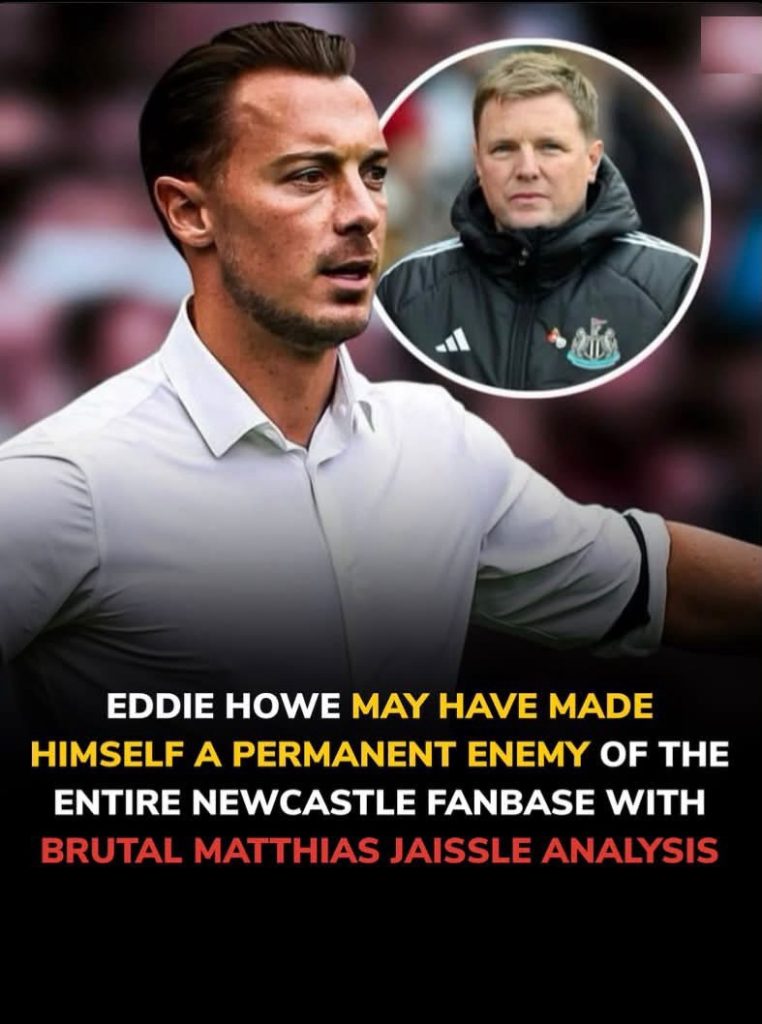
However, the fallout from the defeat has now developed into a much bigger talking point, with Eddie Howe becoming the centre of an increasingly heated debate following the reported reaction to Matthias Jaissle’s post-match comments.
EDDIE HOWE FACES FURIOUS NEWCASTLE UNITED BACKLASH AFTER BRUTAL MATTHIAS JAISSLE COMMENTS SPARK MASSIVE FANBASE DIVIDE
Newcastle United supporters are still reeling after another painful away defeat, with the Magpies suffering a humiliating 4-1 loss against newly promoted Coventry City at the CBS Arena. The scoreline alone was enough to leave the travelling Toon Army devastated, but the manner of the performance has made the situation even more difficult to accept.
Four goals conceded, defensive mistakes at crucial moments and a worrying inability to turn possession into meaningful results have left supporters demanding answers. Newcastle arrived hoping to demonstrate their quality and respond positively, but instead they departed with serious questions hanging over the team, the manager and the club’s direction.
However, the fallout from the defeat has now developed into a much bigger talking point, with Eddie Howe becoming the centre of an increasingly heated debate following the reported reaction to Matthias Jaissle’s post-match comments.
The former Newcastle manager remains a significant figure in the club’s recent history, and his time at St James’ Park continues to generate strong opinions among supporters. While some fans remain grateful for his contribution, others believe the club must now move forward without allowing the past to overshadow the present.
Jaissle, who took charge following Howe’s departure, faced the cameras after watching his side suffer a damaging defeat. Rather than attempting to disguise the disappointment or offer excuses, the Newcastle boss reportedly acknowledged the shortcomings of his team and apologised to the supporters who had travelled to watch the match.
His words struck a nerve because many Newcastle fans wanted precisely that kind of accountability after witnessing such a frustrating afternoon.
But with tensions already running high, the reported controversy surrounding Howe’s reaction has added another layer of uncertainty to an already difficult situation.
NEWCASTLE FANS DEMAND ANSWERS AFTER COVENTRY HUMILIATION
The 4-1 defeat against Coventry City was the kind of result that can quickly change the mood around a football club.
Newcastle supporters travelled with hopes of seeing their team produce a convincing performance, but the final score left them questioning why a side with considerable attacking talent could be so vulnerable when faced with an opponent willing to exploit its weaknesses.
Coventry deserve credit for taking their opportunities, applying pressure and punishing Newcastle when the visitors failed to defend properly. The hosts demonstrated that determination, organisation and clinical finishing can cause serious problems for a team that struggles to maintain its concentration.
For Newcastle, however, the defeat represented more than simply a bad afternoon.
Supporters were particularly frustrated by the goals conceded and the apparent lack of urgency when the match began slipping away. Every defensive mistake increased the pressure, while every missed opportunity made the eventual result feel even more painful.
Newcastle have built a reputation for competing with intensity, and their supporters expect commitment regardless of the opposition or the circumstances.
That expectation is especially high when the team has invested considerable effort in building a squad capable of competing at a demanding level.
Losing away from home is part of football. Suffering a heavy defeat is also something every club experiences occasionally. What supporters find difficult to accept is a performance that leaves them questioning whether the players understood the importance of the occasion.
The travelling fans had committed their time and money to supporting the team. They wanted a performance that reflected their dedication.
Instead, they were left contemplating another disappointing result and searching for an explanation.
JAISSLE’S POST-MATCH HONESTY ATTRACTS ATTENTION
Following the defeat, Matthias Jaissle faced the uncomfortable responsibility of explaining what had gone wrong.
The Newcastle manager reportedly apologised to the supporters who had made the journey and acknowledged that his team had failed to show the necessary hunger when it mattered most.
His comments about the desire to finish attacks were particularly significant.
Newcastle may have enjoyed periods of possession and created opportunities, but those positive statistics meant little once Coventry had scored four times. Football is ultimately decided by what happens in both penalty areas, and Newcastle were punished for failing to convert their attacking play into an effective result.
Jaissle’s reported admission suggested that he recognised the difference between controlling parts of a match and actually controlling its outcome.
Possession without purpose can leave a team exposed. Attacking without sufficient determination can allow opponents to recover their defensive shape. Meanwhile, defensive uncertainty can undo the work of an entire team in a matter of minutes.
For Newcastle, the challenge is to address all three problems.
Supporters generally appreciate a manager who acknowledges mistakes rather than attempting to blame referees, individual incidents or circumstances outside his control.
An apology does not automatically repair the damage, but it can demonstrate that the manager understands the disappointment experienced by the people who support the club.
That is why Jaissle’s response has become such an important part of the discussion.
Newcastle fans want to see evidence that the defeat has been taken seriously and that the coaching staff are prepared to make difficult decisions when necessary.
Words are only the beginning. The real test will come in the team’s performances over the matches that follow.
WHY EDDIE HOWE REMAINS A SENSITIVE SUBJECT
Eddie Howe’s connection with Newcastle United means that discussions about the club’s current direction inevitably invite comparisons with his time in charge.
Howe played an important role in the modern Newcastle story, helping establish a new sense of ambition during a period when supporters wanted to see the club compete more consistently.
His work earned him considerable respect among sections of the fanbase, particularly because supporters could identify with the commitment and intensity associated with his teams.
However, football supporters rarely agree unanimously about former managers.
Some believe Howe deserves continued appreciation for what he contributed. Others argue that once a manager leaves, the focus must shift entirely towards the person responsible for the team today.
The tension becomes even greater when results deteriorate.
After a heavy defeat, supporters often look backwards for comparisons, asking whether the club was better organised previously, whether important players were managed differently and whether decisions made during a managerial transition have helped or harmed the team.
Such questions are normal in football, particularly at a club with Newcastle’s passionate following.
Nevertheless, criticism of a current manager should not automatically become an attack on a predecessor, and praise for a former manager should not be used to dismiss every problem facing the present team.
Newcastle’s immediate responsibility is to understand why they conceded four goals against Coventry and what must change to prevent another performance of the same nature.
The debate surrounding Howe should not distract from that task.
THE REPORTED COMMENTS SPARK A FANBASE DIVIDE
The suggestion that Howe’s reaction to Jaissle’s post-match comments has angered Newcastle supporters has added fuel to an already emotional discussion.
However, without a verified direct quotation or an independently confirmed account of Howe’s response, it would be unfair to present claims about his exact words or intentions as established fact.
What is clear is that the situation has created a compelling talking point about loyalty, accountability and the relationship between Newcastle’s past and present.
For supporters who believe Jaissle deserves time to establish his methods, any perceived attempt to undermine the new manager would be unwelcome.
They want the club to move forward rather than remain trapped in endless comparisons with the previous regime.
From that perspective, the manager should be judged on his own decisions, the quality of his performances and his ability to improve the team.
Other supporters may take a different view.
Fans who remain deeply attached to Howe could argue that his contribution should not be forgotten simply because a successor is struggling. They may believe that honest criticism of the current situation is necessary, especially if performances fail to meet expectations.
Both positions reflect a familiar reality of football: supporters can share the same ambition for their club while disagreeing completely about how it should be achieved.
The danger comes when those disagreements become more important than the actual football.
Newcastle need a clear plan, a united dressing room and a manager capable of delivering consistent performances. Arguments about personalities will not solve defensive problems or turn missed chances into goals.
The club must ensure that the noise surrounding the managerial debate does not become another obstacle to progress.
FOUR GOALS CONCEDED RAISE SERIOUS DEFENSIVE QUESTIONS
The most troubling aspect of Newcastle’s defeat was the number of goals they conceded.
Shipping four goals away from home inevitably invites scrutiny of the defensive structure, the midfield’s ability to protect the back line and the team’s reaction when possession is lost.
A defensive collapse is rarely explained by one player alone.
Centre-backs may be exposed when the midfield fails to close passing lanes. Full-backs may struggle when attacking transitions leave them isolated. Goalkeepers may face difficult situations when opponents are allowed to shoot from dangerous positions without sufficient pressure.
That does not mean individual errors should be ignored.
Players must take responsibility for their decisions, particularly when mistakes directly contribute to goals. However, the coaching staff must also examine whether the tactical approach gives those players the best possible chance of succeeding.
Against Coventry, Newcastle will need to understand how their opponents created opportunities, which spaces were repeatedly exposed and whether the team responded effectively after conceding.
The psychological side of defending also matters.
Once a team falls behind, players can become anxious, rush decisions or abandon their original structure in an attempt to recover the situation. One mistake can quickly become two, and a difficult afternoon can turn into a humiliating result.
That is why Newcastle must develop the ability to remain organised even when circumstances become uncomfortable.
A team with genuine ambitions cannot expect to win every match, but it must show that it can respond when a game begins to move against it.
The 4-1 defeat provides a painful opportunity to examine those weaknesses before they become a recurring problem.
POSSESSION MEANS LITTLE WITHOUT END PRODUCT
Jaissle’s reported comments about a lack of hunger in the final phase of attacks also raise important questions about Newcastle’s attacking approach.
Modern football frequently places enormous emphasis on possession, passing accuracy and territorial control. Those figures can help explain how a team approaches a match, but they cannot tell the entire story.
A side can complete numerous passes without creating enough clear chances. It can dominate the ball while allowing opponents to remain comfortable defensively. It can also create promising openings but fail to deliver the final pass, shot or movement required to score.
Newcastle must find a better balance between controlling possession and attacking with purpose.
That means moving the ball quickly when opportunities appear, making intelligent runs behind defenders and ensuring that players arriving in the penalty area are ready to attack crosses and rebounds.
It also requires the right mentality.
Attackers must be prepared to take responsibility in decisive moments. Midfielders must recognise when a forward pass is available rather than automatically choosing the safest option. Players must show enough composure to make the correct decision under pressure.
These improvements cannot be achieved through criticism alone.
They require repetition on the training ground, clear tactical instructions and a shared understanding of what the manager expects.
Jaissle will also need to assess whether his current approach suits the players available to him or whether adjustments are necessary.
A manager’s responsibility is not simply to demand better performances. It is to identify the reasons those performances are not happening and find practical solutions.
THE PRESSURE ON JAISSLE IS GROWING
A 4-1 defeat inevitably increases scrutiny of a Newcastle manager, particularly when supporters believe the team should be capable of delivering much better performances.
Jaissle now faces the challenge of convincing the fanbase that this result will become a turning point rather than the beginning of a worrying pattern.
The most effective response would be a visible improvement in defensive discipline, attacking efficiency and the team’s overall intensity.
Supporters do not necessarily demand perfection. They understand that football contains setbacks, injuries, difficult fixtures and periods when results fail to reflect the quality of a performance.
What they want is progress.
If Newcastle can demonstrate that the players have learned from the Coventry defeat, the anger surrounding the result may gradually give way to renewed confidence.
However, another disorganised display would make it increasingly difficult for the manager to convince supporters that the necessary changes are taking place.
Jaissle must therefore strike a balance between remaining faithful to his footballing principles and adapting when those principles are not producing the required results.
He must also ensure that his players understand their responsibilities, both individually and collectively.
The manager cannot defend every mistake on the pitch, but he must establish standards that make repeated failures less likely.
The coming fixtures will offer an important indication of whether Newcastle are capable of responding positively.
NEWCASTLE SUPPORTERS WANT ACTION, NOT JUST APOLOGIES
The Toon Army have never been a quiet fanbase.
Newcastle supporters are known for their emotional investment in the club, their willingness to travel and their desire to see a team that represents them with pride.
That passion can create an extraordinary atmosphere when results are positive. When performances deteriorate, however, the same passion can turn into intense frustration.
The Coventry defeat has left supporters wanting more than explanations.
They want to see players tracking runners, competing for second balls, defending crosses properly and showing greater urgency when attacking opportunities arise.
They also want the manager to make decisions that reflect the seriousness of the situation.
That could mean tactical adjustments, changes to the starting line-up or a more direct approach when the team struggles to create clear chances.
Whatever the solution, the priority must be improving the football.
The debate over Howe and Jaissle may dominate conversations in the short term, but supporters will ultimately judge the situation by what happens on the pitch.
A convincing performance in the next match would not erase the disappointment of losing 4-1, but it could demonstrate that Newcastle are moving in the right direction.
Another defeat, particularly one marked by the same defensive mistakes and lack of attacking conviction, would inevitably intensify the criticism.
THE BIG QUESTION: CAN NEWCASTLE MOVE FORWARD?
Newcastle now find themselves facing two connected challenges.
The first is immediate: recovering from a humiliating defeat and correcting the problems that allowed Coventry to score four goals.
The second concerns the club’s wider direction, including how supporters respond to the departure of Howe and whether Jaissle can establish his own identity without being constantly compared with his predecessor.
Those challenges cannot be solved by choosing sides in a public argument.
Howe’s contribution to Newcastle’s recent history can be recognised without treating every decision made during his tenure as beyond criticism. Equally, Jaissle can be held accountable for poor performances without being denied the opportunity to improve the team.
Football demands that managers are judged on results, performances and their ability to learn from setbacks.
Newcastle’s supporters will want evidence that the club’s leadership understands the seriousness of the Coventry defeat and that the players are prepared to respond.
The manager must now turn his post-match words into meaningful improvements.
Meanwhile, any controversy involving Howe should be judged on verified comments rather than rumours or assumptions about his intentions.
Until the details of his reported reaction are established, declaring that he has permanently alienated the entire Newcastle fanbase would be premature.
What cannot be disputed is that the defeat has created anger, questions and renewed debate about the club’s managerial transition.
For Newcastle, the only lasting solution is to start producing better performances.
The 4-1 loss against Coventry was a painful reminder that possession and reputation mean little without discipline, determination and clinical finishing.
Jaissle has acknowledged the disappointment, and supporters will now expect his team to demonstrate that the message has been understood.
As for Howe, his legacy at St James’ Park remains part of the club’s story, but the current team’s future will ultimately be determined by what happens next.
Newcastle need unity, accountability and a clear response.
The supporters have made their frustration known. Now they want to see action on the pitch.


