

Another particularly harsh assessment suggested that the player should be representing a League One side rather than occupying an important position in Sunderland’s team.
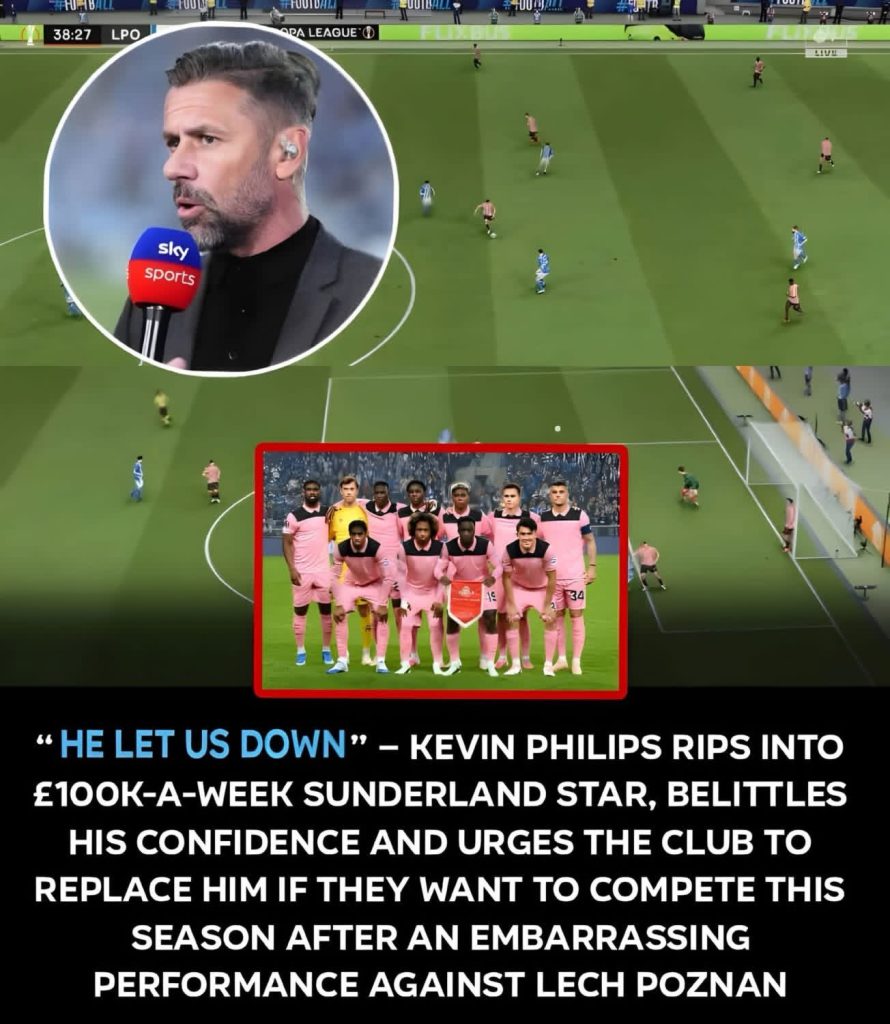
“He Should Be Playing for a League One Team!” — Kevin Phillips Rips Into £100k-a-Week Sunderland Star and Demands Replacement After Costly Performance
Sunderland have been handed another major talking point after club legend Kevin Phillips was linked to a brutal assessment of one of the club’s highly paid stars, with questions surrounding his performances, confidence and ability to deliver when the pressure is at its highest.
The former Sunderland striker is renowned for his outspoken views on football, and the criticism surrounding the Black Cats’ performances has reignited debate about whether every player in Régis Le Bris’s squad is performing at the level required to compete consistently at the highest level.
The controversy centres on a player reportedly earning £100,000 per week, a figure that would place enormous expectations on his shoulders. Supporters naturally expect footballers on such lucrative contracts to demonstrate consistency, composure and leadership, particularly during difficult moments when their teams need them most.
Several angry reactions have captured the mood among frustrated supporters.
“He’s behind all the goals conceded, get rid of him!”
“He wasn’t himself, it’s clear to everyone.”
“He’s always anxious when it comes to big games.”
Another particularly harsh assessment suggested that the player should be representing a League One side rather than occupying an important position in Sunderland’s team.
Such comments reflect the intensity of the debate surrounding Sunderland’s ambitions, although the precise remarks attributed to Phillips and the identity of the player would need independent confirmation before they could be treated as verified quotations.
For Sunderland, the wider issue is clear: expectations are rising, scrutiny is increasing, and performances will inevitably be examined more closely as the campaign progresses.
Sunderland’s growing ambitions bring greater scrutiny
Sunderland’s return to the Premier League has placed the club under a different level of pressure. The Black Cats are no longer judged solely on their ability to compete with familiar Championship opponents. They must now demonstrate that their squad possesses the quality, mentality and consistency required to succeed against elite opposition.
That change in expectations has affected the conversation around individual players.
A mistake that might once have attracted limited attention can become a major talking point when it contributes to a damaging result. Similarly, a poor performance against a strong opponent can prompt questions about whether a player has the temperament to handle football at the highest level.
For Régis Le Bris, managing those expectations is an important part of his job.
The Sunderland head coach must maintain confidence within his dressing room while ensuring that every player understands the standards expected of them. That balance becomes particularly challenging when supporters begin questioning the performances of established first-team players.
Players with significant reputations and expensive contracts are often among the first to attract criticism when results disappoint.
However, wages alone cannot determine a footballer’s value. Tactical responsibilities, injuries, fitness, the quality of opposition and the performances of teammates all influence what happens on the pitch.
Nevertheless, supporters have every reason to demand consistency from players entrusted with important roles in the squad.
Why confidence has become part of the debate
One of the most significant aspects of the criticism is the suggestion that the player appears anxious during major matches.
Confidence can make a substantial difference in professional football. A confident defender is more likely to commit decisively to a challenge, maintain concentration under pressure and make sensible decisions when opponents attempt to exploit weaknesses.
When confidence disappears, even experienced footballers can begin making mistakes they would ordinarily avoid.
A defender might hesitate before stepping forward, lose track of an opponent or clear the ball without properly assessing the available options. A midfielder might become reluctant to receive possession in dangerous areas, while an attacking player could struggle to make the right decision in front of goal.
These problems can become more noticeable against stronger opponents, who are often quicker to punish uncertainty.
However, it would be unfair to conclude that a player lacks courage or ability simply because he has struggled in particular matches.
Footballers experience fluctuations in form, and confidence can be affected by several factors, including tactical changes, injuries, criticism from supporters and the pressure of representing a club with a passionate fanbase.
The challenge for Le Bris is to establish whether any difficulties are temporary or whether the player requires a different role, additional support or a period away from the starting lineup.
A manager cannot afford to ignore repeated mistakes, but neither should he automatically abandon a player after a difficult spell.
The £100,000-a-week question
The reported £100,000 weekly wage has added another dimension to the discussion.
For many supporters, such a salary represents a level of financial commitment that must be matched by performances. They expect a player earning that amount to make a meaningful contribution, demonstrate professionalism and deliver when the team faces its toughest challenges.
Over the course of a year, a salary of £100,000 per week would amount to approximately £5.2 million before bonuses and other contractual considerations.
That is a substantial investment for any football club.
However, the reported figure should not be treated as confirmed without reliable information about the player’s contract. Footballers’ salaries are frequently misreported, and published estimates do not always reflect actual agreements.
Even so, the debate highlights a familiar issue in modern football: when a club commits significant resources to a player, the expectations surrounding that investment naturally increase.
Supporters want to see evidence that expensive contracts are helping the team improve.
For Sunderland, that means evaluating performances through more than one lens. A player’s contribution should be measured through consistency, tactical discipline, availability, leadership and the ability to influence important matches.
A high salary does not guarantee success, but it does ensure that performances will attract considerable attention.
Tutierov’s memorable moment offers Sunderland encouragement
Amid the wider discussion surrounding Sunderland’s squad, Tutierov’s first senior goal represented a positive moment for the team.
The breakthrough was particularly memorable for the player, who reached an important milestone in his career by finding the net at senior level.
Scoring a first senior goal can provide a significant confidence boost, especially for a young footballer attempting to establish himself within a competitive first-team environment.
For the team, an early goal can also change the rhythm of a match. It allows players to settle into their tactical responsibilities, gives the coaching staff greater flexibility and places immediate pressure on the opposition to respond.
Sunderland’s ability to make the most of such moments will be important as they attempt to build consistency across their campaign.
The goal also provided an opportunity to celebrate an individual achievement at a time when conversations about the squad’s strengths and weaknesses have attracted attention.
For developing players, these moments can be particularly valuable. They provide evidence that patience, hard work and opportunities at senior level can produce tangible rewards.
However, one positive contribution should not be used to distract from legitimate questions about the team’s overall performance.
Le Bris must continue assessing the squad collectively, identifying the players who can be trusted in different situations and ensuring that individual achievements translate into stronger team performances.
Europa League progress provides another test
Sunderland’s European campaign has added another layer to the demands facing the club.
The team have been described as having started their Europa League journey positively, with victories over AZ Alkmaar and Torreense providing encouragement ahead of subsequent fixtures.
Those results, recorded as 1-0 against AZ Alkmaar and 2-1 against Torreense in the supplied account, would give the squad reasons to believe that it can compete effectively in Europe.
However, the precise competition context and match details should be checked against official records before being presented as established fact.
European football presents different challenges from domestic competition. Managers must consider travel, recovery periods, tactical variations and the physical demands of playing several matches within a short period.
Squad depth therefore becomes especially important.
A player who struggles in one match may be required again only a few days later. Equally, a footballer who has been waiting for an opportunity could suddenly become important because of rotation, injuries or a change in tactical approach.
Le Bris must decide which players can maintain their performances across different competitions.
If Sunderland are serious about progressing, the manager will need dependable contributions throughout the squad rather than relying exclusively on a small group of established starters.
That is why the discussion surrounding individual consistency matters. Every player must be prepared to contribute when called upon.
Should Sunderland consider replacing the player?
The strongest criticism directed at the unnamed star is the demand that Sunderland find a replacement.
Such calls are common when supporters become frustrated with repeated mistakes, but replacing an established player is not always a straightforward solution.
First, the manager must determine whether the problem lies primarily with the individual or with the team’s wider defensive structure.
A defender can appear responsible for several goals when the real issue involves poor protection from midfield, ineffective pressing or a failure to maintain the correct shape.
Similarly, a goalkeeper can be blamed for conceding goals that result from defensive errors, while a full-back may struggle because he is repeatedly exposed to two opposing attackers.
That does not mean individual accountability should disappear.
If a player repeatedly makes avoidable errors, loses concentration or fails to follow tactical instructions, the manager must consider whether another option would improve the team.
Competition for places is an important part of maintaining standards.
Le Bris could respond to disappointing performances by adjusting the starting lineup, changing the player’s responsibilities or offering an alternative from the bench. Those decisions would allow Sunderland to assess whether the team performs better with a different combination.
A permanent replacement, however, would require careful consideration of availability, cost, squad balance and the transfer market.
Recruitment decisions should be based on evidence rather than the emotional reaction to a single match.
What Kevin Phillips’ criticism would mean
Phillips occupies a special place in Sunderland’s history, and his views would naturally attract attention if he publicly questioned the quality of a current player.
Former players often possess a valuable understanding of the demands associated with representing a club. They know that technical ability is only one part of the equation and that consistency, mental strength and responsibility are equally important.
Nevertheless, strong criticism can have consequences.
Public comments suggesting that a footballer is not good enough for his current level can intensify pressure on that individual, particularly when supporters begin repeating the same assessment across social media.
That pressure can sometimes motivate a player to respond positively. In other cases, it can make an already difficult period even more challenging.
The most productive response would be for the player to focus on his performances, work with the coaching staff and demonstrate that he can be trusted in demanding situations.
If Phillips has made the alleged comments, the full context would also matter. A headline or isolated quotation may not accurately capture the complete argument.
Until the original interview or recording is available, the claims should not be presented as verified statements from the former Sunderland striker.
Le Bris faces an important decision
For Le Bris, the priority must remain Sunderland’s results and the development of a reliable team.
The manager must be willing to make difficult decisions when performances fall below expectations. Reputation and salary cannot guarantee a starting position, and every player should understand that selection depends on what they contribute to the team.
At the same time, the coach must resist allowing outside criticism to dictate his decisions.
A footballer who is struggling may still possess the experience and qualities needed to recover his form. The manager’s responsibility is to determine whether the player can make that recovery while helping the team achieve its objectives.
That requires honest conversations, detailed performance analysis and a clear understanding of what needs to improve.
If the player continues to struggle, a spell on the bench could provide an opportunity to reset. If his performances improve, he could quickly silence the critics.
Either outcome would be more meaningful than judging his future solely through the strength of the criticism directed at him.
Sunderland supporters will demand answers on the pitch
The debate surrounding the reported £100,000-a-week star highlights the expectations that accompany Sunderland’s ambitions.
Supporters want players who can perform consistently, remain composed under pressure and take responsibility when the team faces difficult moments.
They also want to see a squad capable of handling the demands of domestic and European football without allowing individual weaknesses to undermine collective progress.
Tutierov’s first senior goal provides an example of the positive moments that can emerge when players receive opportunities and make them count. The challenge is to ensure that such moments form part of a broader pattern of progress.
For the player facing criticism, the next performances will be crucial. Strong displays could help restore confidence and change the conversation, while further mistakes would inevitably invite additional scrutiny.
For Le Bris, the task is to separate emotion from evidence and make decisions that strengthen the team.
And for Phillips, if the reported criticism is authentic, the central question is whether Sunderland possess the right personnel to meet their growing ambitions.
Ultimately, football is judged on the pitch. Wages, reputations and past achievements can only carry a player so far. Consistency, discipline and performances in important matches are what determine whether a footballer earns the trust of his manager and supporters.
Sunderland’s response to the criticism will therefore be more important than the noise surrounding it. The Black Cats must focus on improving their performances, protecting their confidence and ensuring that every player contributes to the standards required for success.