
For many fans, the defeat was not simply about losing another match. It was about the manner in which Sunderland performed, the opportunities they failed to take, and the mistakes that supporters believe contributed to a disappointing result.
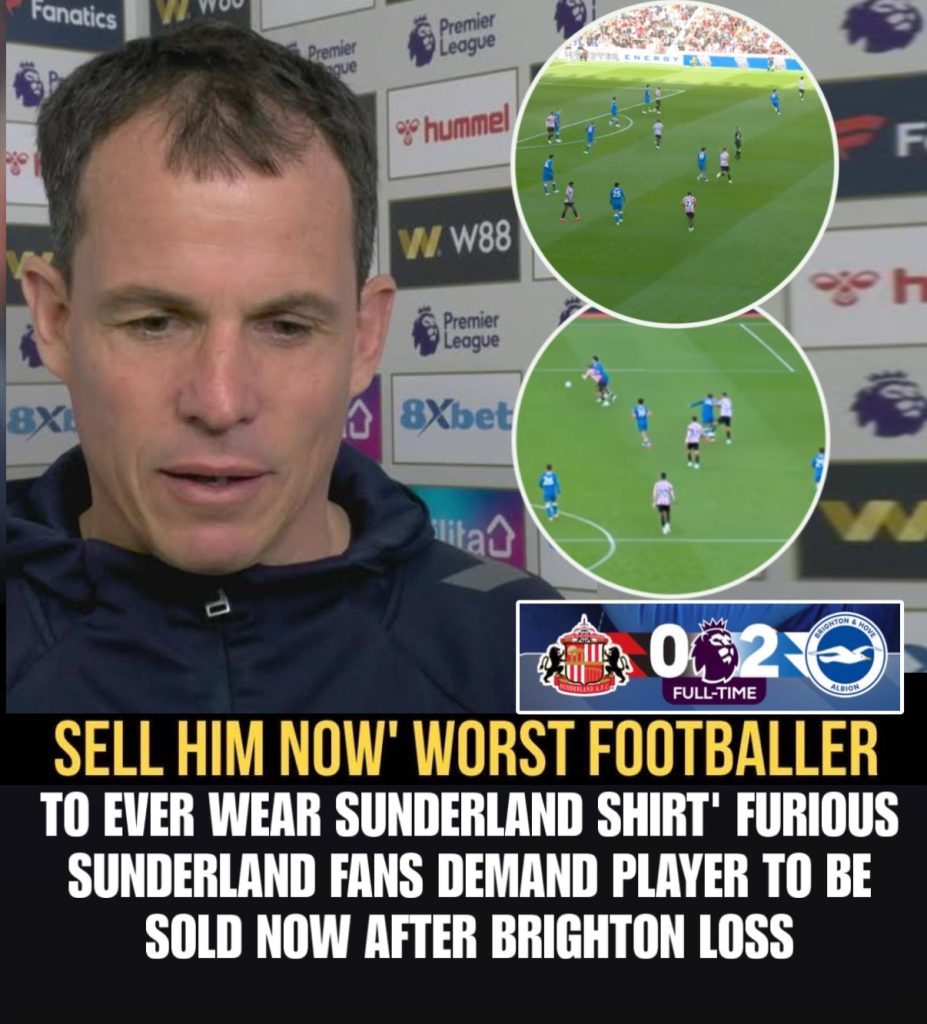
“WORST FOOTBALLER TO EVER WEAR THE SUNDERLAND SHIRT!” — FURIOUS SUNDERLAND FANS TURN ON THEIR OWN PLAYER AFTER DISASTROUS 0-2 DEFEAT TO BRIGHTON
Sunderland supporters have been left absolutely furious after the Black Cats suffered a disappointing 2-0 home defeat to Brighton, with one player becoming the centre of a storm of criticism following a performance that left sections of the fanbase questioning his quality, confidence and suitability for the team.
What should have been an opportunity for Sunderland to make a statement in front of their home supporters instead turned into a frustrating afternoon, with Brighton leaving the Stadium of Light with all three points. The result was painful enough for the home crowd, but the anger that followed the final whistle was directed towards an individual whose display had become a major talking point among Sunderland supporters.
For many fans, the defeat was not simply about losing another match. It was about the manner in which Sunderland performed, the opportunities they failed to take, and the mistakes that supporters believe contributed to a disappointing result.
Social media quickly filled with angry reactions, with some supporters delivering particularly harsh assessments of the player they believed had failed to meet the required standard.
One furious supporter wrote: “Worst footballer to ever wear the Sunderland shirt!”
Another added: “He’s not Premier League quality. I honestly don’t understand how he continues to get opportunities.”
A third supporter expressed their frustration, saying: “Easily one of our worst signings ever. I’ve never been more annoyed at a Sunderland player.”
Although such comments reflect the anger of frustrated supporters rather than an objective assessment of the player’s entire career, they demonstrate just how quickly the mood can change when a team delivers a performance that falls below expectations.
For Sunderland, the challenge now is to respond to the disappointment and prevent one difficult afternoon from developing into a more damaging period of uncertainty.
SUNDERLAND SUPPORTERS LEFT FUMING AFTER BRIGHTON DEFEAT
The Stadium of Light is a ground where Sunderland supporters expect commitment, determination and performances that reflect the passion of the people in the stands.
When those expectations are not met, the reaction can be unforgiving.
The 2-0 defeat to Brighton has left supporters asking serious questions about what went wrong and whether certain players are doing enough to justify their places in the starting eleven.
Losing at home is always difficult to accept, particularly when supporters arrive expecting their team to compete aggressively and make life uncomfortable for the opposition.
However, the frustration becomes even greater when fans believe that individual errors, poor decision-making or a lack of confidence have prevented the team from achieving a better result.
Brighton ultimately took advantage of their opportunities, while Sunderland were left searching for answers.
The defeat has therefore created an uncomfortable atmosphere around the team, with supporters demanding improvements and calling on the players to show greater responsibility.
For the player who has become the focus of the criticism, the situation is particularly difficult.
Football supporters can be incredibly patient when they see effort, determination and signs of improvement. However, when performances repeatedly fall below expectations, patience can quickly disappear.
That appears to be the feeling among sections of the Sunderland fanbase following the Brighton encounter.
The strongest criticism has centred on whether the player possesses the quality and composure required to perform consistently at the highest level.
Some supporters believe the manager must reconsider his position in the team, while others are questioning whether the club made the right decision in bringing him to Sunderland in the first place.
Such criticism is severe, but it reflects the disappointment surrounding a result that Sunderland supporters desperately wanted to avoid.
BRIGHTON MAKE SUNDERLAND PAY
Brighton arrived at the Stadium of Light knowing that an organised performance and clinical finishing could give them an excellent opportunity to secure a valuable away victory.
The visitors eventually achieved exactly that, scoring twice to condemn Sunderland to a frustrating 2-0 defeat.
For Sunderland, the result highlighted the difference between competing in a match and doing enough to win it.
Possession, energy and periods of attacking pressure count for little when a team cannot turn its efforts into goals or prevent the opposition from taking advantage of crucial moments.
Brighton demonstrated the importance of making opportunities count, while Sunderland were left to reflect on a performance that failed to produce the desired outcome.
The home side needed composure, discipline and greater precision in the decisive areas of the pitch.
Instead, the final scoreline left the Black Cats with nothing to celebrate.
The disappointment was particularly painful because Sunderland were playing in front of their own supporters, who had hoped to see a much stronger response from their team.
Home matches provide an opportunity to build confidence, establish momentum and demonstrate that the team can compete against difficult opponents.
A defeat of this nature can interrupt that progress and increase the pressure on players who are already struggling to convince the supporters.
Brighton deserve credit for securing the victory, but Sunderland’s performance will inevitably attract scrutiny.
Supporters want to understand why their team failed to deliver, whether the problems were tactical or individual, and what changes might be necessary before the next match.
For the player at the centre of the criticism, those questions have become particularly uncomfortable.
“HE’S NOT PREMIER LEAGUE QUALITY” — FANS QUESTION HIS ABILITY
Among the most damaging comments directed towards the Sunderland player is the suggestion that he is not good enough to compete at Premier League level.
That accusation goes beyond criticism of one poor performance.
It raises questions about whether the player can consistently handle the speed, physical demands, technical quality and pressure associated with the division.
The Premier League is an unforgiving environment. Small mistakes can have significant consequences, and opponents are often capable of identifying and exploiting weaknesses.
Players must therefore demonstrate concentration, tactical awareness and confidence, particularly when their teams are under pressure.
Sunderland supporters expect every member of the squad to understand those demands.
When a player struggles to deliver the expected standard, fans naturally begin to question whether the manager should continue trusting him.
The Brighton defeat has intensified those concerns among supporters who believe the individual did not do enough to help the team.
One of the most frustrating aspects of football for supporters is watching a player struggle without seeing an immediate improvement in his performances.
Fans may forgive an isolated mistake, especially when the player responds positively in subsequent matches.
However, frustration can grow when similar concerns continue to dominate discussions after disappointing results.
That is why some Sunderland supporters have begun questioning whether the player should remain in the starting eleven.
Their argument is straightforward: if the team is expected to compete consistently, selection must be based on performance, reliability and the ability to meet the demands of the competition.
Nevertheless, one defeat should not automatically determine a player’s entire future.
Footballers can experience difficult periods, and a poor display does not necessarily mean that an individual lacks the ability to improve.
The important question is whether the player can respond to criticism, regain confidence and demonstrate that he deserves another opportunity.
The next performances could prove crucial in determining how supporters view him.
“ONE OF OUR WORST SIGNINGS EVER” — TRANSFER DECISION UNDER SCRUTINY
The anger has also extended beyond the player’s performance to the decision to sign him.
Some supporters have described the transfer as one of Sunderland’s worst recruitment decisions, arguing that the club should have invested its resources in a player capable of delivering greater consistency.
Such accusations can quickly become a major talking point whenever a signing struggles to make the expected impact.
Recruitment is one of the most important responsibilities at any football club. Managers and sporting directors must identify players who can improve the squad, fit the tactical system and cope with the demands of the competition.
When a signing fails to meet expectations, supporters naturally begin asking whether the club made the right assessment.
However, judging a transfer requires more than looking at one result.
The player’s performances across multiple matches, his role within the team, his adaptation to the club and the expectations surrounding the move must all be considered.
A player who struggles initially may eventually become an important member of the squad.
Equally, a signing who receives repeated opportunities without demonstrating sufficient improvement can become increasingly difficult to defend.
For Sunderland, the priority must be determining whether the player remains an important part of the team’s plans and what support or changes might help him improve.
The club must also consider whether alternative options within the squad offer greater reliability.
Supporters will expect those decisions to be based on performances rather than reputation, transfer fees or the desire to justify previous recruitment choices.
Ultimately, the best way to answer questions about a signing is through what happens on the pitch.
If the player responds positively, the criticism may gradually disappear.
If the problems continue, however, the calls for the club to reconsider his role are likely to become louder.
THE PRESSURE ON THE MANAGER IS GROWING
Although much of the anger has focused on an individual player, the manager cannot completely escape responsibility for the team’s performance.
Managers select the starting eleven, establish tactical instructions and decide how to respond when a match begins to move away from their plans.
When a team loses 2-0 at home, supporters will inevitably examine those decisions.
Some will question whether the right players were selected, while others will ask whether substitutions or tactical adjustments could have changed the outcome.
The manager must also determine how to protect players who are struggling without ignoring legitimate concerns about their performances.
There is a delicate balance between maintaining confidence within the dressing room and demonstrating that standards will not be compromised.
Publicly abandoning a player after one disappointing performance can damage confidence and create further uncertainty.
However, repeatedly selecting an underperforming footballer without visible improvement can also frustrate supporters and undermine confidence in the manager’s judgement.
Sunderland’s coaching staff must therefore assess the Brighton defeat carefully.
They need to identify the mistakes that contributed to the result, examine the team’s overall performance and decide which changes would give Sunderland the best chance of responding positively.
If the criticised player remains in the starting eleven, he will need to demonstrate that the manager’s faith is justified.
If he is dropped, the decision will need to be accompanied by a convincing performance from whoever replaces him.
Either way, Sunderland cannot afford to allow the defeat to become an excuse for further poor displays.
The supporters want evidence that lessons have been learned.
SUNDERLAND CANNOT AFFORD TO LOSE CONFIDENCE
One of the biggest dangers following a disappointing defeat is the impact it can have on a team’s confidence.
Footballers are often judged on their ability to recover from setbacks, and the response to a difficult result can be just as important as the performance that preceded it.
Sunderland must now avoid allowing frustration to spread throughout the squad.
The players need to remain focused, work on their weaknesses and approach their next challenge with renewed determination.
That responsibility becomes even more important for the individual facing the strongest criticism.
When supporters question a player’s quality, every subsequent touch of the ball can attract additional attention.
A misplaced pass, a missed opportunity or a defensive mistake may be greeted with groans that make an already difficult situation even more challenging.
The player must therefore demonstrate mental strength as well as technical ability.
Responding to criticism does not mean attempting to silence everyone with one spectacular moment. It means consistently making the right decisions, working hard for the team and showing that mistakes will not define future performances.
A determined display in the next match could help restore some confidence.
A series of reliable performances would be even more valuable.
Supporters are generally willing to reconsider their opinions when a player demonstrates genuine improvement.
However, they will want to see action rather than excuses.
For Sunderland, rebuilding confidence must be a collective responsibility.
The defence must remain organised, the midfield must compete effectively and the attack must become more decisive in front of goal.
No individual can solve every problem alone, but every player must contribute to the team’s recovery.
FANS DEMAND A RESPONSE AFTER THE FINAL WHISTLE
The reactions following the Brighton defeat reveal just how disappointed sections of the Sunderland fanbase have become.
Supporters invest enormous amounts of time, money and emotion into following their club. They travel to matches, fill the stands and expect the players to represent the badge with determination.
When results go against them, frustration is inevitable.
The strongest criticism is often directed towards the players whom supporters believe are falling short of expectations.
In this case, the anger has been particularly intense, with some fans questioning the player’s suitability for the team and demanding that the manager consider alternative options.
Yet the reaction also highlights the high standards supporters want Sunderland to maintain.
They do not simply want the team to participate in matches. They want to see progress, competitiveness and a clear commitment to improving after setbacks.
A 2-0 home defeat to Brighton has left many questioning whether Sunderland are doing enough to meet those expectations.
The supporters will now look for a response in the next fixture.
They will want to see greater concentration, more effective attacking play and a determination to prevent the mistakes that contributed to the disappointing afternoon.
Above all, they will expect every player to show that representing Sunderland remains a responsibility they take seriously.
The individual at the centre of the controversy will face particular scrutiny, but the entire squad must understand that the responsibility for results is shared.
CAN THE CRITICISED PLAYER TURN THINGS AROUND?
Despite the anger surrounding his performance, the player’s story at Sunderland does not have to end with the Brighton defeat.
Football is full of examples of players who have struggled through difficult periods before rebuilding their reputations through hard work and consistent performances.
The response matters more than the criticism itself.
If the player can identify the areas where he needs to improve, work closely with the coaching staff and demonstrate greater composure on the pitch, he may still have an opportunity to change the narrative.
That will require patience, determination and a willingness to accept responsibility.
He must also understand that supporters are unlikely to be satisfied by a single improved performance if the underlying concerns remain unresolved.
Consistency is what separates a temporary response from genuine progress.
The manager will have to decide whether the player deserves another opportunity immediately or whether a period outside the starting eleven would help him rebuild his confidence.
Neither decision will automatically guarantee success.
What matters is that Sunderland make choices based on what gives the team the best chance of winning.
The club must also avoid allowing social media outrage to dictate its decisions. Supporters’ opinions are important, but selection and recruitment should be guided by a broader assessment of performance, tactics and the team’s needs.
The criticism may be painful, but it also presents an opportunity for the player to prove his doubters wrong.
The question is whether he can produce the response required.
FINAL VERDICT: A BAD DAY THAT COULD HAVE BIG CONSEQUENCES
Sunderland’s 2-0 defeat to Brighton has left the Black Cats facing difficult questions, with one player bearing the brunt of the frustration from supporters who believe his performance fell well below the required standard.
The comments have been brutal.
“Worst footballer to ever wear the Sunderland shirt.”
“He’s not Premier League quality.”
“Easily one of our worst signings ever.”
Those words underline the depth of disappointment among sections of the fanbase, but they should not be confused with a definitive judgement on the player’s entire career.
One match cannot tell the complete story of a footballer’s ability. Nevertheless, performances matter, and Sunderland supporters have made it clear that they expect a significant improvement.
The club must now focus on the issues exposed by the defeat, while the manager faces important decisions about selection, tactics and how best to restore confidence within the squad.
For the player under scrutiny, the next opportunity could be especially important.
He has a chance to respond through his performances, demonstrate his value to the team and begin rebuilding his relationship with supporters.
If he succeeds, the anger surrounding the Brighton defeat may eventually become a difficult memory rather than a defining moment.
If the struggles continue, however, calls for him to be dropped could become increasingly difficult for the manager to ignore.
For now, Sunderland must put the disappointment behind them and concentrate on their next challenge.
The message from frustrated supporters is unmistakable: they want better performances, greater consistency and players who can rise to the demands of wearing the Sunderland shirt.
The response on the pitch will determine whether the club can turn this difficult moment into a turning point.
What do you think, Sunderland fans? Should the manager continue trusting the player after the Brighton defeat, or is it time for him to be dropped from the starting eleven?