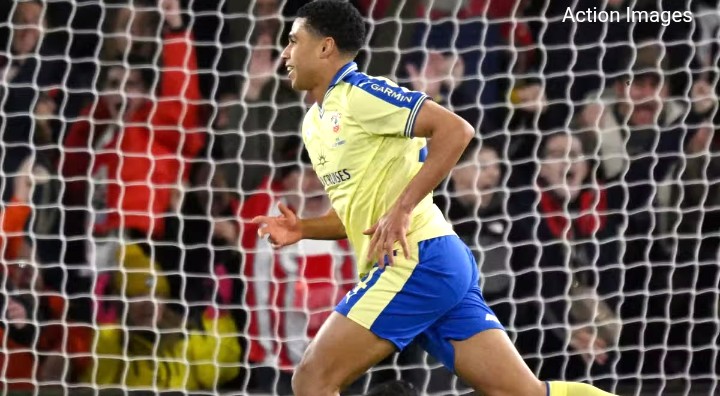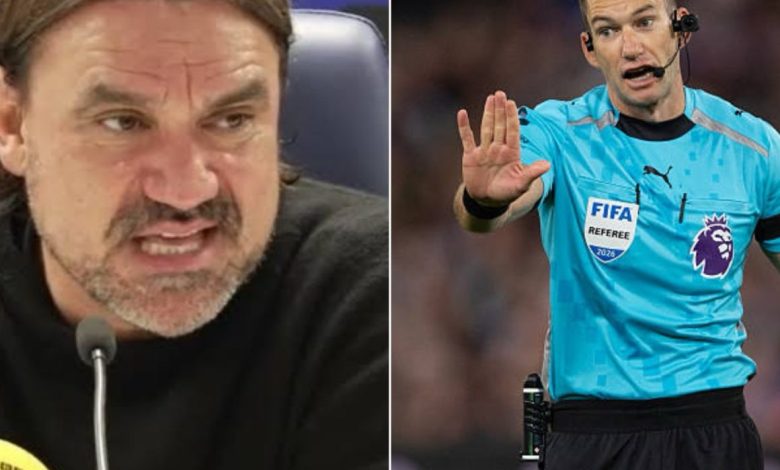
Daniel Farke was left furious after referee Jarred Gillett’s controversial penalty decision played a major role in Chelsea’s extraordinary comeback against Leeds United at Stamford Bridge.
REFEREE JARRED GILLETT RESPONDS TO RAGING DANIEL FARKE AS HE REVEALS REASON BEHIND CONTROVERSIAL CHELSEA PENALTY
Daniel Farke was left furious after referee Jarred Gillett’s controversial penalty decision played a major role in Chelsea’s extraordinary comeback against Leeds United at Stamford Bridge.
What had looked like a dream night for Leeds quickly turned into a nightmare as Chelsea produced a remarkable turnaround, with the penalty decision becoming one of the biggest talking points of the match.
Leeds had stunned Chelsea by racing into a 2-0 lead and appeared to be on course for a famous Carabao Cup victory. Tarik Muharemovic opened the scoring before Brenden Aaronson doubled the advantage shortly after half-time, leaving the home supporters stunned.
Chelsea, however, refused to surrender.
The momentum began to shift, and one of the most controversial moments came when Gillett pointed to the penalty spot following what Leeds believed was only minimal contact inside the area.
Farke and his players immediately protested.
The Leeds manager was visibly unhappy with the decision and questioned how such a soft challenge could result in a penalty at such a crucial stage of the match.
From the Leeds perspective, the decision completely changed the atmosphere of the contest.
Instead of Chelsea having to find a way back into the game through open play, they were handed an opportunity from the penalty spot.
The pressure increased.
The home crowd became louder.
And Leeds suddenly found themselves defending a lead that had appeared almost unassailable only moments earlier.
The controversy has continued to dominate discussions surrounding the match, with supporters debating whether the contact was sufficient to justify a penalty.
Farke’s frustration was understandable.
His team had worked extremely hard to establish a two-goal advantage at Stamford Bridge, and the Leeds boss believed his players deserved more protection in a moment that could ultimately determine the outcome of the tie.
However, Gillett’s response to the criticism has provided another side to the story.
The referee’s explanation was that he did not consider the contact in isolation. Instead, the decision was based on what he believed was an illegal challenge that affected the Chelsea player’s ability to continue his movement inside the penalty area.
That distinction is important.
A challenge does not necessarily have to be violent or spectacular for a referee to award a penalty. The key question is whether the defender’s action unfairly impeded the attacking player.
That was apparently the basis for Gillett’s decision.
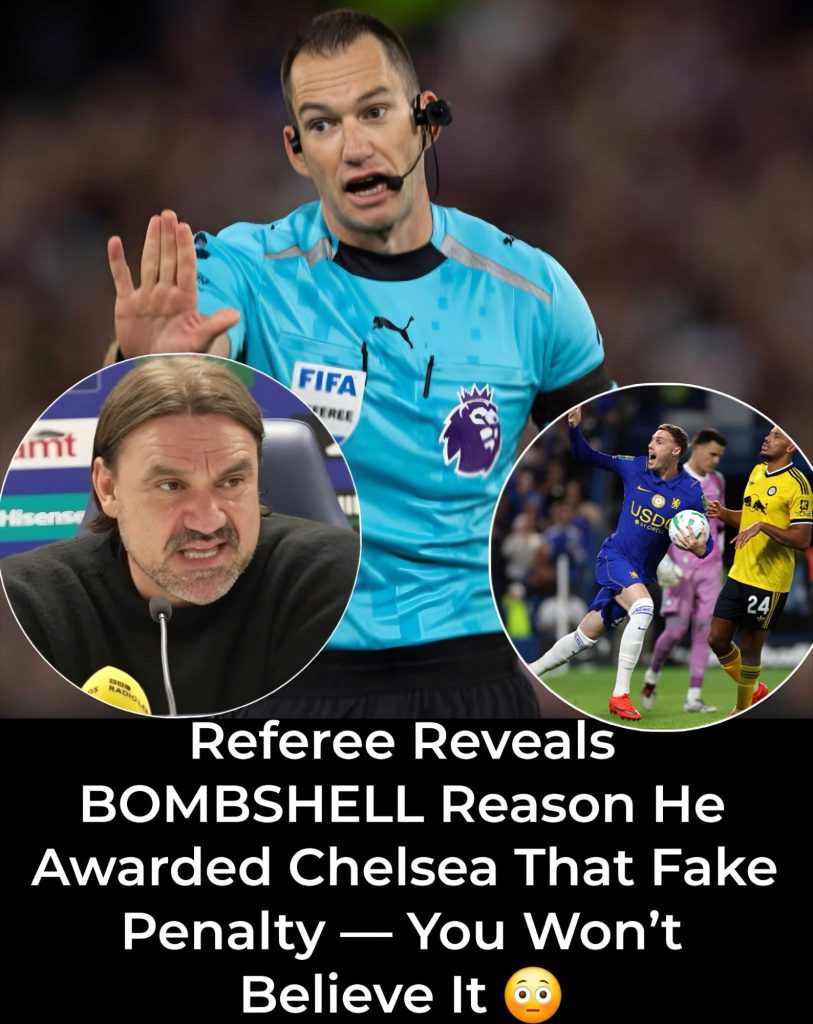
For Leeds supporters, though, the explanation is unlikely to make the controversy disappear.
Many fans felt that the level of contact was far too small to justify awarding a penalty, particularly in a knockout match where one decision could completely change the direction of the game.
The frustration became even greater because of what happened afterwards.
Chelsea took advantage of the opportunity and suddenly looked like a completely different team.
The psychological impact was enormous.
Leeds had gone from believing they were minutes away from eliminating Chelsea to desperately trying to regain control of a match that had suddenly become chaotic.
Chelsea’s confidence surged while Leeds’ defensive organisation began to disappear.
The home side continued to attack with increasing intensity, and the visitors struggled to deal with the pressure.
Within a short period, the game had transformed from a potential Leeds triumph into one of the most dramatic collapses of their season.
The eventual 6-3 scoreline made the turnaround even more remarkable.
Leeds had been 2-0 ahead.
They had looked comfortable.
They had stunned Stamford Bridge.
And then Chelsea scored six goals to completely destroy the visitors’ advantage.
For Farke, however, the penalty decision remains one of the moments that cannot simply be ignored.
The Leeds manager knows his team had defensive problems to address after conceding six goals, particularly after holding such a strong position. But he also believes that major refereeing decisions deserve scrutiny when they occur during decisive moments.
The debate surrounding Gillett’s decision is therefore unlikely to end with the final whistle.
Some supporters believe the referee made the correct call because even minor contact can constitute a foul if it prevents an opponent from playing the ball or continuing their run.
Others believe football has reached a point where attackers are being rewarded too easily for minimal contact, particularly inside the penalty area.
That disagreement is exactly why the incident has generated so much discussion.
For Leeds fans, the feeling is simple: the contact did not look serious enough to justify a penalty.
For Chelsea supporters, the argument is equally straightforward: if a defender makes illegal contact inside the box, the referee has every right to award the spot-kick regardless of the scoreline.
Gillett’s explanation therefore offers clarification, but it does not necessarily settle the argument.
There is also a wider question about how referees should handle such incidents in high-pressure matches.
A referee must make a decision in real time, often within seconds, while dealing with players surrounding him, thousands of supporters reacting and the enormous consequences attached to every call.
VAR can provide another layer of review, but even video evidence does not always remove disagreement because football decisions often involve interpretation.
The Chelsea-Leeds controversy is a perfect example.
One person sees a foul.
Another sees normal football contact.
One supporter sees a clear penalty.
Another sees an undeserved gift.
That is what makes the incident so divisive.
Farke will now have to turn his attention towards the lessons Leeds can take from the defeat.
A two-goal lead at Stamford Bridge should have provided the foundation for progression in the Carabao Cup. Instead, the team collapsed spectacularly.
The penalty may have changed the momentum, but Leeds’ inability to respond afterwards will also concern the manager.
Conceding six goals after leading 2-0 highlights serious defensive problems.
Farke will know that blaming the referee alone cannot explain such a dramatic collapse.
Nevertheless, the Leeds boss is entitled to question decisions that he believes went against his team.
For Gillett, the message is equally clear: he stands by the decision and believes the contact met the threshold for a penalty.
That response will do little to calm angry Leeds supporters, particularly those who believe their side were denied the chance to finish the job on the pitch.
The extraordinary comeback has therefore created two separate stories.
Chelsea will celebrate an incredible fightback and their ability to recover from a disastrous start.
Leeds will be left wondering how a match they appeared to control at 2-0 ended in a stunning 6-3 defeat.
And in the middle of it all sits one controversial penalty decision that has sparked a fierce debate between supporters, players and the Leeds manager.
Whether fans agree with Gillett or Farke will ultimately depend on how they interpret the contact.
But one thing is undeniable: the penalty became a major turning point in a match that completely changed direction.
Leeds had Stamford Bridge stunned.
Chelsea looked vulnerable.
Then came the controversial decision.
The momentum shifted.
And suddenly, the night belonged entirely to Chelsea.
For Farke and Leeds, the painful question will remain: what if that penalty had never been awarded?