
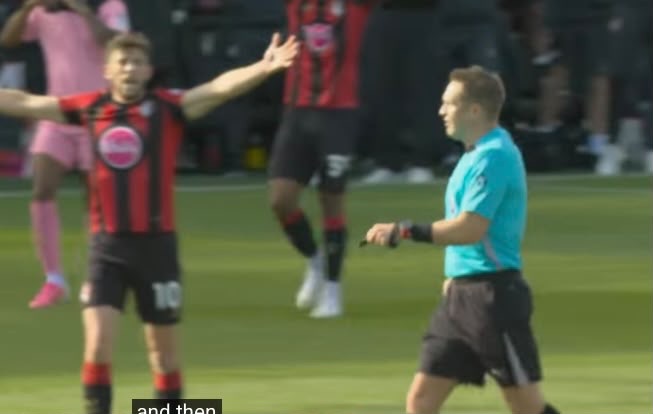
For supporters, the issue goes beyond one player receiving a red card. It concerns how referees interpret dangerous situations, how VAR intervenes in crucial moments and whether similar incidents are being judged consistently across different Premier League fixtures.
SHOCKING! PREMIER LEAGUE BREAKS SILENCE HOURS AFTER SUNDERLAND GAME WITH OFFICIAL STATEMENT ON PAUL MERSON’S CLAIMS OVER KEVIN DANSO’S RED CARD AGAINST BOURNEMOUTH
The Premier League has reportedly addressed the controversial red-card decision involving Kevin Danso following the incident that sparked widespread debate among football supporters, with Paul Merson’s claims adding another layer of discussion to an already heated refereeing controversy.
The incident, which occurred during the clash involving Tottenham Hotspur and Bournemouth, has become a major talking point among fans questioning the consistency of refereeing decisions in the Premier League. With emotions running high and supporters demanding greater clarity over the application of the rules, attention has turned towards the official explanation provided by the league’s Match Centre.
The decision to send Danso off for denying an obvious goalscoring opportunity immediately attracted attention, particularly because of the potential impact such a dismissal can have on the outcome of a closely contested match.
For supporters, the issue goes beyond one player receiving a red card. It concerns how referees interpret dangerous situations, how VAR intervenes in crucial moments and whether similar incidents are being judged consistently across different Premier League fixtures.
Paul Merson’s comments have further intensified the conversation, encouraging supporters to examine the incident and consider whether the officials made the correct decision.
However, the league’s explanation of the VAR review provides an important starting point for understanding why the dismissal was upheld.
PREMIER LEAGUE EXPLAINS THE VAR DECISION
According to the supplied Matchweek 7 VAR review, the Premier League Match Centre confirmed that the referee’s decision to dismiss Danso for denying an obvious goalscoring opportunity had been checked and upheld by VAR.
The explanation stated that Bournemouth forward Evanilson had possession of the ball before being pulled to the ground by Danso outside the penalty area.
Following a review of the incident, the officials supported the decision made by referee Craig Pawson to show a straight red card.
The explanation is significant because it clarifies the reasoning behind the dismissal. Rather than treating the incident as an ordinary foul, the officials considered whether Danso had prevented an opponent from having an obvious opportunity to score.
That distinction is crucial under the Laws of the Game.
A foul does not automatically result in a red card simply because it occurs outside the penalty area. Referees must consider the circumstances surrounding the incident, including the attacker’s position, the direction of play, the likelihood of controlling the ball and the presence of defenders who could intervene.
When those factors indicate that a player has denied an obvious goalscoring opportunity through an offence punishable by a direct free kick, a red card may be justified.
In Danso’s case, the explanation indicated that the officials believed the circumstances met the required threshold.
The fact that the incident occurred outside the penalty area did not prevent the referee from issuing a dismissal. Indeed, some of the most difficult decisions involving obvious goalscoring opportunities happen outside the box, where defenders must decide whether to challenge an advancing attacker or allow the move to continue.
For the officials, the central question was whether Evanilson had been denied a clear opportunity to progress towards goal by the defender’s actions.
Their conclusion was that the red card should stand.
WHY THE INCIDENT HAS GENERATED SO MUCH DEBATE
Although the Premier League’s explanation provides the official reasoning, it does not necessarily end the debate among supporters.
Red-card decisions are among the most consequential moments in football because they can change the tactical balance of a match almost immediately.
When a team loses a player, its manager may be forced to reorganise the defence, withdraw an attacking player or abandon an original tactical plan.
The remaining players must cover additional ground, maintain their concentration and attempt to prevent the opposition from exploiting the numerical advantage.
For the dismissed player, the consequences can extend beyond the match itself. A straight red card may also lead to a suspension, depending on the nature of the offence and the applicable disciplinary regulations.
This explains why incidents involving an alleged denial of an obvious goalscoring opportunity attract such intense scrutiny.
Supporters naturally want to know whether the defender had any realistic chance of avoiding the foul, whether the attacker was genuinely in a position to score and whether another defender could have prevented the opportunity from developing.

These questions are particularly important when the incident occurs at a decisive stage of a match.
The Premier League’s explanation identifies the key consideration in this particular case: Evanilson was in possession before Danso pulled him to the ground.
That detail forms an important part of the officials’ assessment, but the wider interpretation of an obvious goalscoring opportunity still depends on the complete circumstances of the incident.
Football supporters may disagree about those circumstances, even when the referee and VAR reach a clear conclusion.
PAUL MERSON’S CLAIMS ADD FUEL TO THE CONTROVERSY
Paul Merson’s involvement in the debate has helped draw further attention to the incident.
The former Arsenal midfielder is a familiar voice in English football discussions, and his opinions on major refereeing decisions often become subjects of conversation among supporters.
When a high-profile pundit questions a decision, fans frequently revisit the available footage, compare the incident with similar situations and debate whether the officials reached the correct conclusion.
That is particularly true when a red card is involved.
However, without the precise wording of Merson’s original comments, it would be inappropriate to attribute a specific quotation or definitive position to him.
What can be established from the supplied account is that his claims became part of the discussion surrounding Danso’s dismissal.
The official explanation now gives supporters a clearer understanding of the reasoning behind the decision, allowing the debate to focus on the relevant laws rather than speculation about what the referee or VAR may have considered.
There is also an important distinction between an official explanation and a universal agreement that a decision was correct.
The Premier League can explain why its officials supported a particular call, but supporters, analysts and former players remain free to examine whether the reasoning was convincing.
That disagreement is a normal part of football, especially when a decision has a significant impact on a match.
UNDERSTANDING THE RULE ON DENYING AN OBVIOUS GOALSCORING OPPORTUNITY
The Laws of the Game provide specific guidance for situations in which a player denies an opponent an obvious goalscoring opportunity.
Under Law 12, a player can be sent off for denying an opponent a goal or an obvious goalscoring opportunity through an offence punishable by a direct free kick or penalty kick, subject to the relevant exceptions.
Officials generally assess several important factors when making that judgment.
The first is the distance between the attacker and the goal. An attacker who is approaching the penalty area with a clear route towards goal may present a greater scoring threat than one who is much farther away.
The second consideration is the general direction of play. If the attacker is moving towards goal with the ball under control, the likelihood of a genuine goalscoring opportunity may be greater.
The third factor is the likelihood of controlling or keeping possession of the ball. A loose ball, a difficult touch or an uncertain opportunity may affect the referee’s assessment.
Finally, officials consider the positions and number of defenders who could realistically intervene.
These factors are not simply a checklist that can be applied mechanically. Referees must judge the overall situation, using the available evidence to determine whether the opportunity was obvious.
That is why two incidents that initially appear similar can lead to different outcomes.
One defender might foul an attacker who is about to move into a clear one-on-one situation with the goalkeeper. Another might commit a similar foul against an attacker who is moving away from goal or has several defenders positioned to intervene.
The nature of the offence, the direction of play and the defensive cover can make a substantial difference.
In the incident involving Danso, the Premier League’s explanation indicates that the officials concluded that the foul on Evanilson met the criteria for a red card.
WHAT ROLE DID VAR PLAY?
The introduction of the Video Assistant Referee system was intended to help officials correct clear and obvious errors involving major match incidents.
VAR can review potential red-card offences and advise the on-field referee when the evidence suggests that a decision requires reconsideration.
However, VAR is not designed to replace the referee in every disputed situation.
The on-field official remains responsible for the final decision, and the review process is subject to specific intervention criteria.
In a potential denial-of-an-obvious-goalscoring-opportunity incident, VAR can examine the available camera angles and help establish the relevant facts.
Those may include the location of the foul, the movement of the attacker, the position of the ball and the availability of other defenders.
If the referee has issued a red card and the VAR review does not establish grounds for overturning it, the original decision may stand.
That appears to be the outcome described in the supplied account of the Danso incident.
The Premier League Match Centre confirmed that the decision had been checked and upheld.
For supporters, this raises another familiar question: if VAR reviews a decision, why does disagreement continue?
The answer is that technology can help establish what happened, but football decisions frequently involve interpretation.
A replay can show where a defender made contact and whether an attacker was pulled down. Determining whether the attacker had an obvious goalscoring opportunity still requires the officials to apply the Laws of the Game to those facts.
VAR can improve the information available to the referee, but it cannot remove every subjective judgment from football.
WHY THE LOCATION OF THE FOUL MATTERS
The fact that the incident occurred outside the penalty area is another reason the decision has attracted attention.
Some supporters may assume that a foul outside the box should automatically result in a free kick rather than a red card.
That is not how the rules work.
A direct free kick can be accompanied by a red card when the offence meets the criteria for denying an obvious goalscoring opportunity.
The goalkeeper does not have to be directly involved in the incident for a dismissal to be justified.
For example, if an attacker breaks through the defensive line and is fouled by the last covering defender, the referee may determine that a clear opportunity to score has been denied.
However, being the last defender is not, by itself, an automatic reason for a red card. The referee must consider the complete situation.
Similarly, a defender who commits a foul outside the penalty area may escape a red card if the attacker was not in an obvious goalscoring position or if other defenders could realistically challenge for the ball.
This is why the Premier League’s explanation matters.
By identifying Evanilson’s possession and the action that brought him to the ground, the review provides the official basis for supporting Pawson’s decision.
Whether every supporter agrees with that interpretation is a separate question.
THE PRESSURE ON PREMIER LEAGUE REFEREES
The controversy also highlights the pressure facing Premier League referees.
Officials are expected to make split-second decisions while players move at high speed, stadiums are filled with noise and managers demand consistency.
A referee may have only a brief moment to determine whether a challenge is a foul, whether the attacker was denied a clear opportunity and whether the appropriate sanction is a yellow or red card.
VAR provides additional support, but it also places individual decisions under intense public scrutiny.
Every major incident can be replayed from multiple angles, discussed by pundits and debated across social media.
That level of attention means referees must be prepared to explain difficult decisions and accept that their judgments will be questioned.
Transparency is therefore important.
When the Premier League publishes an explanation of a controversial incident, it gives supporters an opportunity to understand the reasoning behind the decision.
Nevertheless, consistency remains essential.
Fans want similar situations to be judged according to the same principles, regardless of which clubs are involved, who the referee is or how important the match might be.
If supporters believe that one team receives a different interpretation from another, confidence in the officiating system can suffer.
The challenge for the Premier League is to demonstrate that its decisions are grounded in the Laws of the Game and that VAR is being used consistently.
WHAT THE DECISION MEANS FOR DANSO AND HIS TEAM
A dismissal can have immediate consequences for a player and his teammates.
Once a defender is sent off, the manager must reconsider the team’s shape and defensive responsibilities.
The remaining defenders may have to narrow their positions, midfielders may be required to track back more frequently, and the forward line could lose support as the team attempts to maintain its defensive structure.
These changes can affect the entire match.
For Danso, the decision also places the focus on his judgment during the incident. Defenders must often make difficult decisions when an opponent is moving towards goal, particularly when allowing the attacker to continue could lead to a dangerous opportunity.
However, challenging for the ball always carries a degree of risk.
A defender who mistimes a challenge, grabs an opponent or commits a foul that prevents an obvious goalscoring opportunity can face a serious disciplinary sanction.
The Premier League’s explanation indicates that the officials believed Danso’s actions fell within that category.
Any further consequences would depend on the applicable disciplinary rules and the formal outcome of the incident.
It is important not to assume additional punishment or make claims about the player’s intentions without confirmed information.
SUPPORTERS DEMAND CONSISTENCY AND CLARITY
The response to the incident reflects a broader issue in English football: supporters want clearer explanations when major decisions influence the direction of a match.
For many fans, the frustration is not simply that a player has been sent off. It is the uncertainty surrounding how similar situations are interpreted from one fixture to another.
A decision that appears straightforward to one group of supporters can look completely different to another.
Pundit opinions can intensify those divisions, particularly when former professionals question whether the referee correctly applied the rules.
The official explanation provides a reference point for the discussion, but it does not prevent supporters from reaching different conclusions.
Some will consider the dismissal justified because the officials determined that Evanilson had been denied an obvious goalscoring opportunity.
Others may want a more detailed breakdown of the attacker’s position, the availability of covering defenders and the likelihood that the move would have resulted in a clear chance.
Those are legitimate areas for football analysis.
The most productive debate, however, is one grounded in the actual footage, the applicable rules and the explanation provided by the officials.
Without those elements, criticism can quickly become speculation.
THE FINAL WORD
The Premier League’s reported explanation of Kevin Danso’s red card has placed the focus firmly on the incident involving Evanilson and the rules governing the denial of an obvious goalscoring opportunity.
According to the supplied Matchweek 7 VAR review, the league’s Match Centre confirmed that Craig Pawson’s decision to send Danso off had been checked and upheld.
The stated reasoning was that Evanilson had possession of the ball before being pulled to the ground outside the penalty area, leading the officials to support the straight red card.
Paul Merson’s claims have added to the debate, but the precise nature of his comments should be established before attributing a specific opinion or quotation to him.
Ultimately, the incident illustrates the difficult balance between defensive challenges, refereeing judgment and the use of VAR in modern football.
The rules allow officials to issue a red card for denying an obvious goalscoring opportunity outside the penalty area, provided the relevant criteria are met.
The Premier League’s explanation indicates that its officials believed those criteria had been satisfied in this case.
Whether that explanation convinces every supporter is another matter.
For now, the debate serves as another reminder that major refereeing decisions remain among the most fiercely contested subjects in the Premier League, with fans demanding not only accurate decisions but also consistency, transparency and a clear understanding of how the rules are applied.