
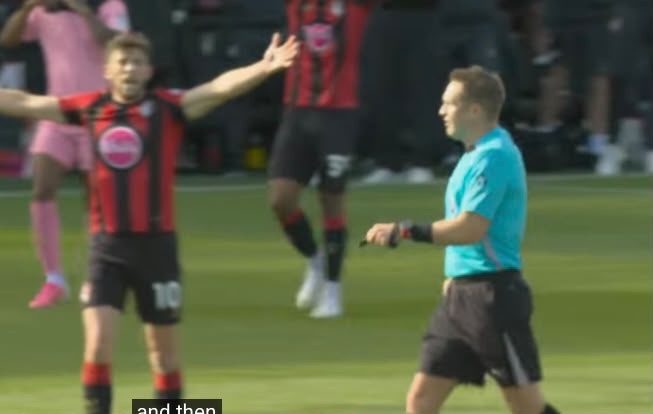
Paul Merson has sparked a major debate over the controversial red-card decision involving Kevin Danso, with claims that the defender should never have been sent off intensifying frustration among Sunderland supporters.
SHOCKING! PAUL MERSON CLAIMS KEVIN DANSO’S RED CARD WAS NEVER A RED AS BOURNEMOUTH FACE CHEATING ACCUSATIONS AFTER SUNDERLAND DEFEAT
Paul Merson has sparked a major debate over the controversial red-card decision involving Kevin Danso, with claims that the defender should never have been sent off intensifying frustration among Sunderland supporters.
The incident has become a major talking point following the clash involving Sunderland and Bournemouth, with questions being raised about the referee’s decision, the role of VAR and whether the better side ultimately received the result they deserved.
For Sunderland supporters, the controversy is about much more than a single disciplinary decision. There is a growing feeling among frustrated fans that their team was let down by the officiating, with some questioning whether Bournemouth benefited from a decision that should have been judged differently.
Merson’s reported position that the incident was never a red card has added further fuel to the argument, particularly among supporters who believe Sunderland were the better side and deserved a different outcome.
The controversy has also reignited discussions about the consistency of Premier League refereeing and whether VAR is delivering the clarity that supporters were promised.
PAUL MERSON QUESTIONS THE RED CARD DECISION
Paul Merson’s reported assessment of the incident has become a major talking point, with the former Arsenal midfielder questioning whether the dismissal was justified.
The decision to issue a straight red card for denying an obvious goalscoring opportunity is one of the most consequential calls a referee can make. Such a decision can immediately change the balance of a match, leaving one team to compete with ten players while the opposition gains a numerical advantage.
That is precisely why incidents of this nature attract so much scrutiny.
If Merson believes the challenge did not warrant a red card, his position raises an important question: did the officials correctly apply the Laws of the Game, or was the punishment too severe?
The distinction matters because not every foul that stops an attacking move automatically qualifies as denying an obvious goalscoring opportunity.
Referees must consider the attacker’s position, the direction of play, the likelihood of controlling the ball and the positions of other defenders.
A challenge can be a foul without necessarily meeting the threshold for a straight red card.
Supporters who agree with Merson’s reported assessment will argue that the officials needed to examine every relevant detail before making such a significant decision.
However, the Premier League’s reported VAR explanation stated that the decision was checked and upheld because Evanilson had possession before being pulled to the ground by Danso outside the penalty area.
That official explanation provides the basis for the referees’ decision, even as questions about its interpretation continue.
SUNDERLAND SUPPORTERS FEEL THEIR TEAM WAS LET DOWN
For Sunderland supporters, the biggest frustration is the belief that their team deserved more from the game.
When a team produces a determined performance, creates opportunities and competes strongly against its opponents, a controversial refereeing decision can become the defining talking point after the final whistle.
Fans naturally want to see their players rewarded for their efforts rather than left discussing decisions made by officials.
Sunderland supporters who believe their side was the better team will argue that the match should be remembered for the football rather than a disputed red card.
Their frustration is understandable, particularly when the dismissal appears to influence the tactical direction of the contest.
Playing against ten men can provide the opposition with additional space and more opportunities to control possession. Meanwhile, the team reduced to ten players must work harder to maintain its defensive shape and protect dangerous areas.
That numerical difference can affect everything from pressing intensity to attacking transitions.
Nevertheless, determining which side was better requires consideration of the complete performance, including chances created, possession, defensive organisation and the quality of opportunities.
The central issue for Sunderland fans remains whether the officials made the correct decision at a crucial moment.
‘BOURNEMOUTH CHEATED TO WIN’ — FANS’ ANGER GROWS
The controversy has prompted fierce reactions, with some angry supporters accusing Bournemouth of benefiting unfairly from the incident.
For those fans, the disputed decision represents a moment that could have changed the direction of the match.
However, there is an important distinction between benefiting from a refereeing decision and deliberately cheating. There is no established evidence in the information provided that Bournemouth deliberately manipulated the officials or committed misconduct.

The criticism is therefore best understood as an expression of supporter frustration rather than a proven allegation against the club.
Football regularly produces situations in which one team believes the referee has made a decisive mistake. The team benefiting from the decision may then face criticism, even when its players had no control over the official’s judgment.
Bournemouth’s responsibility was to compete within the rules, while the referee was responsible for applying them correctly.
That is why the focus should remain on the incident itself and whether the punishment was justified.
If the red card was correct under the Laws of the Game, Bournemouth cannot reasonably be blamed simply for benefiting from it. If the decision was incorrect, questions about the officiating would deserve further examination.
For Sunderland supporters, however, the feeling of injustice may remain until they are convinced that the decision was properly assessed.
WAS SUNDERLAND THE BETTER TEAM?
One of the strongest arguments emerging from the reaction is the belief that Sunderland performed well enough to deserve a better result.
Supporters often judge a match through more than the final score. They consider the team’s intensity, attacking movement, defensive discipline and ability to create dangerous situations.
A team can lose a match while producing encouraging football, just as a team can win without necessarily dominating every aspect of the contest.
For Sunderland, the argument that they were the better side reflects the frustration of fans who believe their players’ efforts were overshadowed by the controversial incident.
If Sunderland were creating opportunities and maintaining pressure before the dismissal, supporters may feel that the red card fundamentally altered the contest.
However, a complete assessment would require the match statistics and footage to establish how the two sides performed across the full ninety minutes.
What cannot be ignored is the effect that a major disciplinary decision can have on the momentum of a game.
Managers prepare their teams with specific tactical plans, but those plans can change instantly when a player is dismissed.
The remaining players must adjust their positions, while substitutions may be required to restore defensive balance.
For a team that believes it was competing on equal terms, such a development can be particularly frustrating.
That is why Sunderland supporters are demanding clarity over the decision rather than simply accepting the result without question.
THE PREMIER LEAGUE’S EXPLANATION UNDER SCRUTINY
The Premier League’s reported VAR explanation stated that the dismissal was reviewed and upheld.
According to that explanation, Evanilson had possession of the ball before Danso pulled him to the ground outside the penalty area, leading the officials to support the straight red card.
That is the official reasoning presented in the supplied account.
However, an official explanation does not automatically mean every supporter or pundit will agree with the interpretation.
The key question is whether the incident satisfied the criteria for denying an obvious goalscoring opportunity.
Officials must assess the attacker’s direction, distance from goal, likelihood of maintaining control and the positions of other defenders.
The fact that a foul occurred outside the penalty area does not prevent a red card. Equally, the fact that a defender stopped an attack does not automatically mean a dismissal is required.
The circumstances determine the appropriate sanction.
This is where Merson’s reported criticism becomes relevant to the wider debate. If his assessment differs from the officials’ conclusion, supporters will naturally want to understand which interpretation best fits the available evidence.
The most useful response would be a clear explanation of the relevant factors, supported by the footage and the applicable law.
That would allow fans to judge the decision based on its merits rather than relying solely on emotional reactions.
VAR WAS SUPPOSED TO REDUCE CONTROVERSY
The introduction of VAR was intended to help referees correct clear and obvious errors in important situations, including potential red-card offences.
Yet incidents such as this demonstrate why technology has not eliminated disagreement from football.
VAR can provide additional camera angles, slow-motion replays and opportunities to examine the sequence of events. It cannot, however, remove every element of interpretation from the Laws of the Game.
Officials still have to decide whether the circumstances justify a red card.
For supporters, the frustration often comes from seeing a lengthy review followed by a decision they believe is wrong.
When that happens, fans question whether VAR is genuinely improving the game or simply reinforcing decisions that remain open to interpretation.
The Premier League therefore faces a continuing challenge: explaining its decisions clearly enough that supporters understand the reasoning, even when they disagree with the outcome.
Consistency is equally important.
Supporters want to know that similar incidents will be judged according to the same standards, regardless of the teams involved or the importance of the match.
If the criteria appear to change from one fixture to another, trust in the officiating system can suffer.
WHAT HAPPENS NEXT?
The debate surrounding Danso’s dismissal is likely to continue among Sunderland supporters, Bournemouth fans and neutral observers who believe the incident deserves closer examination.
Merson’s reported view that it was never a red card has provided another perspective on the controversy, while the Premier League’s explanation sets out why the officials upheld the decision.
The two positions highlight the central disagreement: whether the foul met the threshold for denying an obvious goalscoring opportunity.
For Sunderland, the priority will be moving forward and concentrating on upcoming fixtures rather than allowing frustration over one incident to overshadow the season.
For Bournemouth, the focus will be on its performances and results, while supporters will continue to debate whether the match was influenced by a questionable call.
The wider lesson is that major refereeing decisions need to be judged carefully, using the available evidence and the relevant rules.
Accusations of cheating should not be treated as established fact without evidence of deliberate wrongdoing. Equally, supporters should be able to question decisions and demand greater transparency when they believe their team has been disadvantaged.
FINAL VERDICT: A RED CARD THAT HAS DIVIDED FOOTBALL FANS
Paul Merson’s reported criticism of Kevin Danso’s red card has intensified a debate that was already attracting attention following the controversial incident.
Sunderland supporters believe their team deserved better, with many arguing that the dismissal unfairly influenced the match and questioning whether the referee’s judgment was correct.
The Premier League’s reported explanation maintains that the decision was checked and upheld because Evanilson was in possession before being pulled to the ground.
That gives supporters the official reasoning, but it does not guarantee universal agreement.
The crucial question remains whether all the requirements for denying an obvious goalscoring opportunity were satisfied.
Until the incident is assessed against the full footage and the relevant criteria, claims that the decision was unquestionably wrong would go beyond the information available.
For Sunderland fans, the frustration is clear: they want their team’s performances to determine the outcome, not controversial decisions that leave supporters arguing long after the final whistle.
And with Merson’s reported position adding another voice to the debate, the incident has once again placed Premier League refereeing under the spotlight.